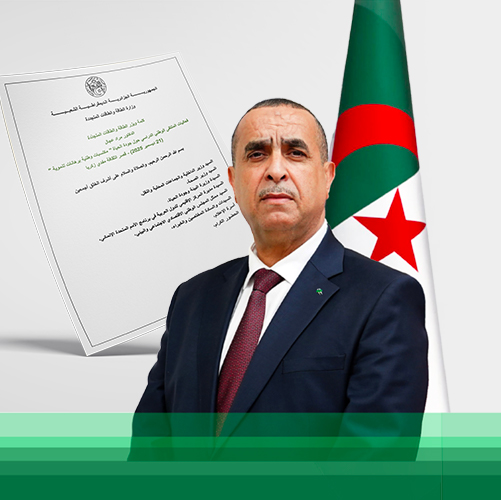
Speech by the Minister of Energy and Renewable Energy, Dr. Mourad Adjal,
During the proceedings of the “Workshop on Climate Finance and Carbon Markets”
Tuesday, 03 November 2026
In the Name of Allah, the Most Gracious, the Most Merciful, and peace and blessings be upon the noblest of Messengers.
- Mr. Prime Minister,
- Mr. Minister of State, Minister of Foreign Affairs, National Community Abroad and African Affairs,
- Mr. Minister of State, Minister of Hydrocarbons,
- Mr. Minister of Finance,
- Mr. Minister of Higher Education and Scientific Research,
- Madam Minister of Environment and Quality of Life,
- Mr. Chairman and Chief Executive Officer of Sonatrach,
- Ladies and Gentlemen, Ambassadors and Representatives of the Diplomatic Corps in Algeria,
- Ladies and Gentlemen, Representatives of National and International Bodies and Institutions,
- Members of the Media, Distinguished Guests,
May the peace and blessings of Allah be upon you.
It gives me great pleasure and honour to be with you today at this workshop on “Climate Finance and Carbon Markets.” At the outset of my address, I would like to extend my thanks to everyone involved in organising this important initiative, which reflects the growing importance Algeria attaches to climate finance, as one of the key areas for keeping pace with the transformations taking place in the field of climate change at the global level.
Today, the world is witnessing profound transformations in its energy systems, driven by climate challenges and technological and economic developments. These transformations call for striking a balance between ensuring energy supply security, achieving economic development, and moving towards more sustainable and less carbon-intensive production and consumption patterns.
In this context, climate finance holds strategic importance as a key instrument for mobilising financial resources and directing investments towards projects that contribute to reducing emissions, developing clean energy, and strengthening the resilience of energy systems, in order to achieve the Sustainable Development Goals and the Paris Agreement on Climate Change.
For Algeria, this approach forms part of a national vision based on a gradual transition towards a more diversified and sustainable energy model, while harnessing national potential in the field of renewable energy, preserving our energy security, and continuing to support the country's economic and social development.
Ladies and Gentlemen,
The Energy and Renewable Energy sector is one of the key drivers of this dynamic, given its central role in achieving the transition towards a more sustainable economy and enhancing the competitiveness of the national economy.
In this regard, the sector is working to implement the National Renewable Energy Development Programme, which aims to achieve a total installed generation capacity of 15,000 MW by 2035.
The programme is primarily based on the development of solar energy, while also incorporating other renewable energy sources, particularly wind energy, biomass and geothermal energy. This programme constitutes a fundamental pillar for diversifying electricity generation sources and reducing the carbon footprint of the national energy system.
The first phase of this programme, with a total capacity of 3,200 MW, is currently under implementation. It is expected to account for 13% of the total installed electricity generation capacity. In this regard, 760 MW have been commissioned to date.
With regard to wind energy, we are working towards launching studies for projects with a total capacity estimated at 200 MW. Wind energy represents an additional source for diversifying electricity generation. This step reflects our country's commitment to expanding the renewable energy base and harnessing the various available natural resources, while also strengthening national expertise in the development and utilisation of this technology.
On the other hand, the development of hydrogen is one of Algeria's future strategic priorities, with the aim of establishing it as a strategic energy carrier, in keeping with its climate commitments and its energy transition programme.
We are convinced that our country possesses significant potential and capabilities that will enable it to become a major regional player in this field, particularly thanks to its solar energy resources and its extensive electricity and gas transmission networks.
It should be noted that the next phase will focus on developing this sector through the implementation of several projects currently under study. These projects will enable us to master all the value chains involved in the development, production and marketing of hydrogen.
Among these projects is the Southern Hydrogen Corridor (SoutH2 Corridor). In this regard, the Ministerial Declaration of Algiers relating to this project was recently signed with our partners (Tunisia, Italy, Austria and Germany). This declaration highlights the strategic importance of the project as an instrument for regional and Euro-Mediterranean integration in the field of green energy.
Ladies and Gentlemen,
The effective realisation of these ambitions requires substantial investments and the provision of appropriate financing mechanisms. From this perspective, the importance of mobilising additional financial resources, facilitating access to concessional financing, developing public-private partnerships, and strengthening international cooperation becomes evident. These measures will help improve the economic and financial viability of forthcoming projects and accelerate their implementation.
Ladies and Gentlemen,
Achieving these objectives requires strengthening coordination and integration among the various national sectors and institutions, as well as enhancing cooperation with international financial institutions and relevant partners. This is essential to benefit from available expertise, develop innovative financing mechanisms, and improve access to financial resources allocated to addressing climate challenges.
Finally, we hope that the proceedings of this workshop will provide a practical opportunity to strengthen dialogue among the various stakeholders, identify appropriate financing mechanisms, and explore investment and partnership opportunities, thereby contributing to supporting Algeria's efforts in the field of energy transition and addressing climate challenges.
Thank you for your kind attention.
May the peace, mercy and blessings of Allah be upon you.